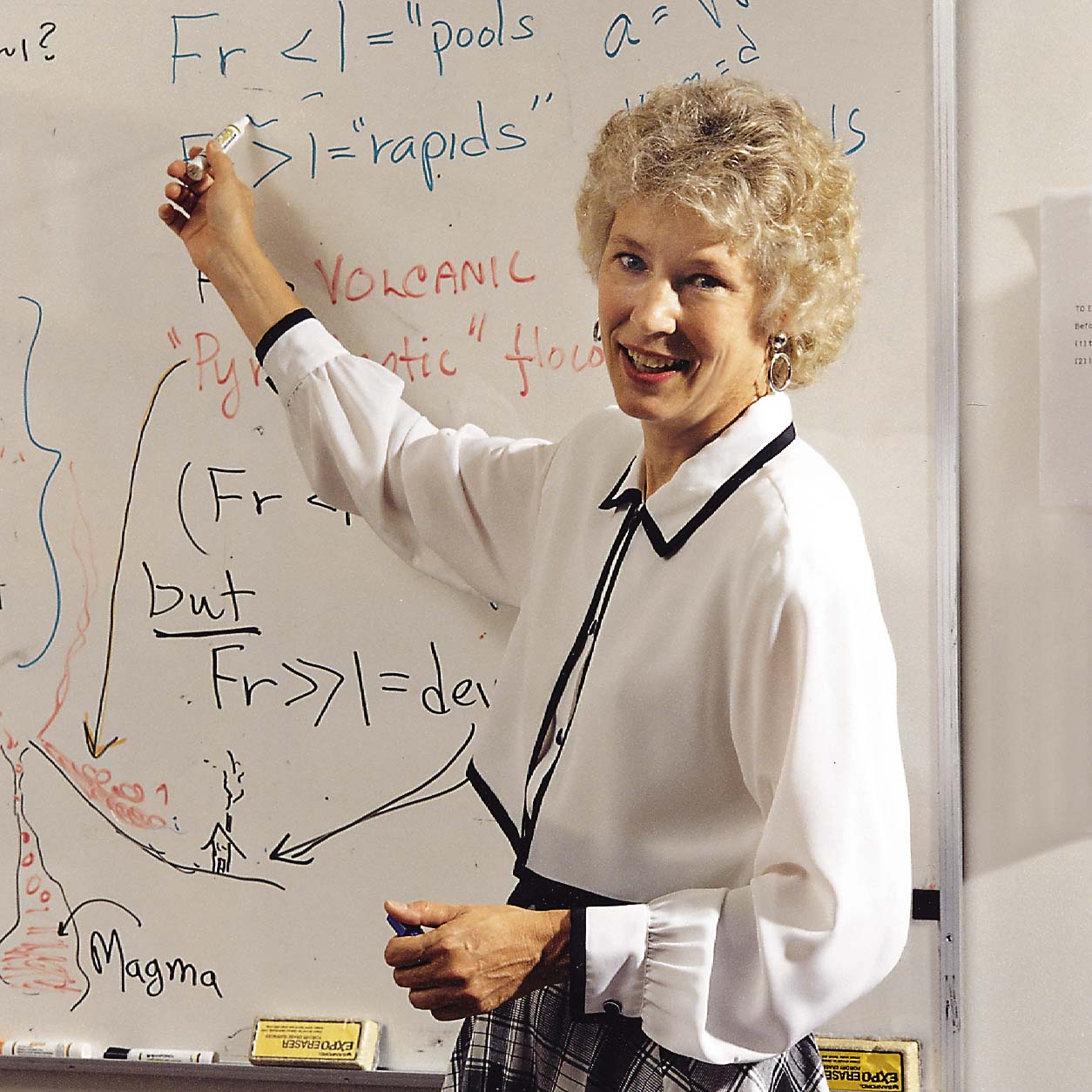
member of the National Academy of Sciences and MacArthur Foundation award winner,
will present two lectures at LSU, March 2 and 3,
as part of the Chancellor's Distinguished Lecture Series.
|
|
Dr. Susan W. Kieffer,
member of the National Academy of Sciences and MacArthur Foundation award winner, will present two lectures at LSU, March 2 and 3,
|
Her main interests are geological physics, including planetary sciences, solid-state geophysics, volcanic environments, theoretical modeling studies of planetary phenomena.and music. "My geology parallels my music practicing," Kieffer said. "I always seem to skip the slow movements to get on to playing the fast ones." Her published works range from lattice dynamics to droplet chondrules to river hydraulics to impact craters. Many of these works appear in the prestigious journals "Science" and "Nature". She has edited the book "Microscopic to Macroscopic: Atomic Environments to Mineral Thermodynamics" published by the Mineralogical Society of America. She is a member of the National Academy of Sciences (elected in 1986), a fellow of the American Academy ofArts and Sciences and the American Geophysical Union, a life fellow of the Mineralogical Society of America, has served on the Canadian Geo-Science Council for disposal of spent nuclear fuel, and is a former Department Head of Geology at the University of British Columbia and a Regent's Professor at Arizona State University. Her many other awards include, in part, an Alfred P. Sloan Foundation Fellowship, the Mineralogical Society of America Award (for outstanding scientists under 35 yrs of age), the Day Medal of the Geological Society of America, the California Institute of Technology, Distinguished Alumus Award and the first Shoemaker-Bowie Lecturer of the American Geophysical Union.
Kieffer is also collaborating with an english teacher to teach science to homeless and at-risk 7-12 graders in Phoenix. Many of these youngsters, Kieffer explained, have low reading skills, low math skills, and the typical teenage fear of math and science. Many of them have shifted schools perhaps four times a year, with each school change costing a half-year in educational advancement. However, working with the youngsters in 1997-98, Kieffer said, "We changed their perception of science and they loved it. Their excitement level was high, and conceptually, they understood complex things like meteors and impact." Equally importanly, the teacher changed her style of teaching and her geology course is one of the most popular in the school for at risk 9-12 graders
For her highly creative work, she received The John D. and Catherine T. MacArthur Foundation Award, described the fellowship program as "a stipend paid over five years to individuals who show exceptional merit and promise for continued and enhanced creative work". Her MacArthur Fellowship allowed her to leave a tenured faculty position and found Kieffer and Woo, Inc., R & D company to develop nonlinear data analysis and prediction techniques.
"MacArthur Fellowships come with no strings attached," Kieffer said. "They hope you will do something for the betterment of humanity. The fellowships give you the permission to explore, so I've tried out being in the private sector as well as the at-risk education project. It's been quite a unique time of life."
(Information adapted from the Illinois Wesleyan University
and the MacArthur Foundation webpages and the speaker's vita.)